
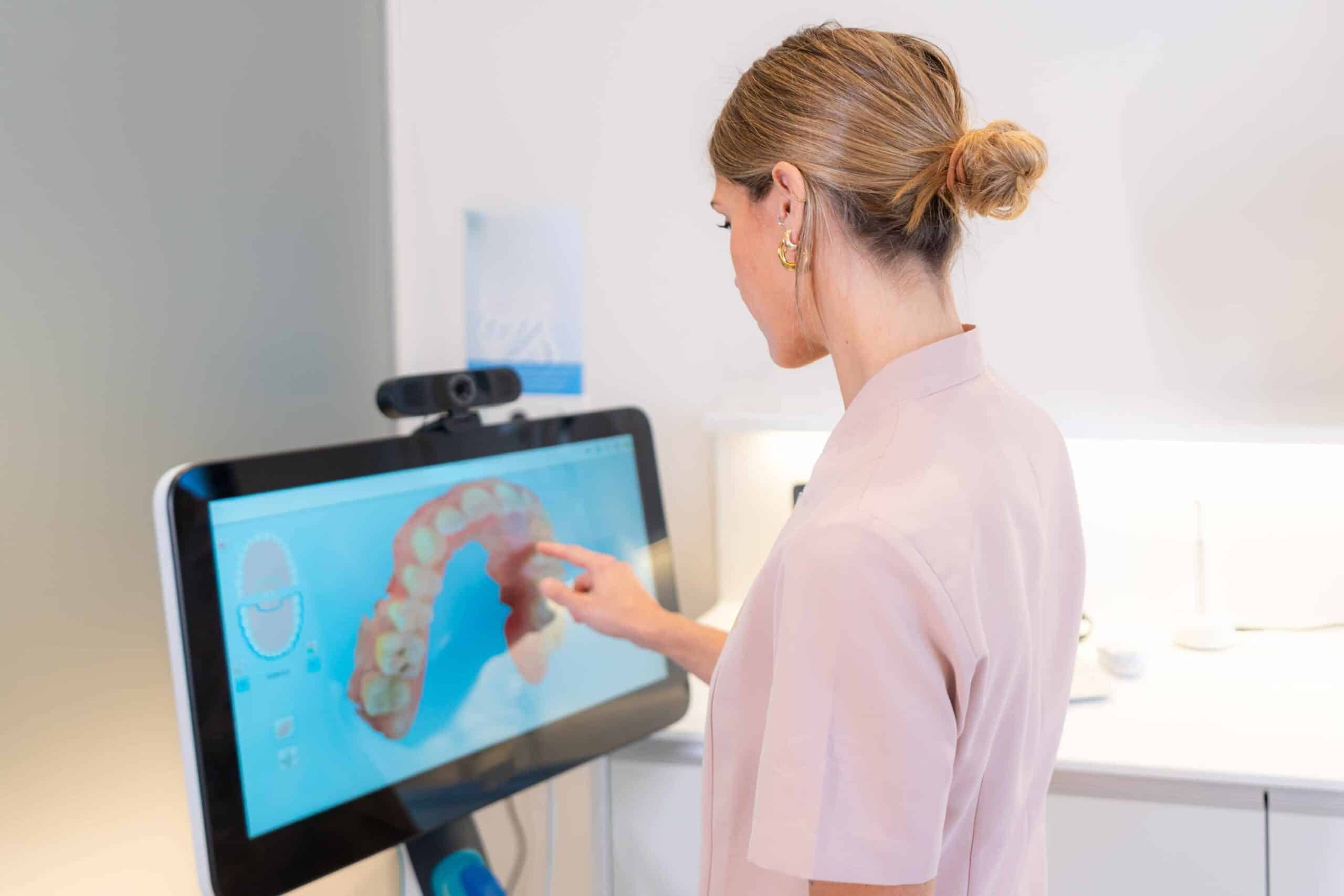
Artificial intelligence is moving quickly into orthodontics.Today, digital systems can analyze dental scans, identify individual teeth, simulate tooth movement and help orthodontists monitor whether aligners are tracking as planned.That raises an increasingly common question:
If AI can design an Invisalign treatment plan, do you still need an orthodontist?
For patients in Hillsboro, OR, the answer is important:
AI can assist with Invisalign planning, but it should not be confused with replacing the diagnosis, judgment and oversight of an orthodontist.
The difference matters because orthodontics isn’t simply about moving teeth from Point A to Point B. Your bite, jaw relationship, roots, gums, bone support, facial structure and individual response to treatment all matter.
Can AI Actually Plan Invisalign?
AI can assist with parts of clear-aligner treatment planning, and the technology is advancing rapidly. Researchers are developing systems that can identify teeth from 3D scans, detect dental landmarks, evaluate proposed tooth movements and simulate treatment sequences.
A 2026 research project called OrthoAI v2 demonstrated an experimental system combining tooth segmentation, landmark detection, biomechanical scoring and treatment simulation for clear-aligner planning. The researchers described it as an AI-assisted planning pipeline, not a replacement for clinical orthodontic care.
This distinction is critical.
AI can process enormous amounts of digital information very quickly. But processing information is not the same as making a complete clinical diagnosis.
What Does an Orthodontist Add?
Consider what happens before an aligner is designed.
An orthodontist needs to determine:
- What is causing the patient’s crowding?
- Is there an overbite or underbite?
- How do the upper and lower jaws relate?
- Are the roots positioned appropriately?
- Is there enough bone and gum support?
- Are there impacted or missing teeth?
- Is Invisalign appropriate for this particular case?
- Would braces provide a more predictable result?
- Are additional procedures necessary?
A digital model can show where teeth are located.
It doesn’t automatically tell the clinician why they are there or what the safest treatment strategy should be. That’s where orthodontic training becomes essential.
Does Invisalign Already Use Digital Technology?
Yes.
Digital treatment planning is not new to Invisalign.
At Laidlaw Orthodontics, the Invisalign process includes X-rays and digital impressions that are used to create a three-dimensional representation of the patient’s teeth and develop customized aligners.
The practice also explains that aligners are changed approximately every one to two weeks as the teeth move through the planned sequence.The important point is that digital technology is being used within orthodontic care. The technology doesn’t eliminate the orthodontist.
It gives the orthodontist better digital information to work with.
Can AI Tell Which Teeth Should Move?
AI can potentially identify tooth positions and calculate proposed movements.
But tooth movement has biological limits. Moving a tooth isn’t like moving an icon across a computer screen. The tooth is surrounded by bone, periodontal tissues and other anatomical structures. An orthodontist must consider whether a proposed movement is clinically appropriate and whether the patient’s tissues can support it.
This is particularly important for movements involving:
- Significant rotations
- Root positioning
- Large amounts of crowding
- Vertical tooth movement
- Bite correction
- Complex spacing
- Impacted teeth
- Skeletal discrepancies
AI may help model these movements.
The orthodontist determines whether the proposed movement makes sense for the patient.
What Happens If AI Gets the Plan Wrong?
This is one of the most important questions patients should ask.
- Suppose a digital treatment simulation looks perfect on a screen.
- The actual teeth don’t necessarily have to follow the simulation exactly.
- Teeth can move differently from the predicted sequence.
- An aligner may not fit correctly.
- A patient may not wear the trays long enough.
- An attachment may come loose.
- A tooth may track more slowly than expected.
- When that happens, the treatment plan may need to change.
Laidlaw Orthodontics specifically notes that Invisalign may not be appropriate for some complex alignment or bite problems and recommends a consultation with Dr. Laidlaw to determine which treatment option is appropriate.
That clinical flexibility is difficult to replicate with a purely automated system.
Can AI Replace Orthodontic Diagnosis?
Not based on current evidence.
AI can analyze images and models extremely efficiently. But diagnosis requires putting those findings into a clinical context. For example, two patients could have similar-looking front-tooth crowding but completely different underlying problems.
One may have a relatively straightforward dental alignment issue. Another may have a significant bite or skeletal discrepancy. Their treatment plans should not necessarily be identical.
An orthodontist evaluates the complete patient rather than relying solely on the appearance of the teeth in a digital model.
What About AI-Powered At-Home Aligners?
Technology has made remote orthodontic services easier to deliver. Patients can take photographs, submit scans and communicate through apps. That can be convenient for appropriate cases. But convenience doesn’t eliminate the need for proper diagnosis and supervision.
Patients should know:
- Who is diagnosing me?
- Who approves my treatment plan?
- Who monitors my tooth movement?
- Who handles complications?
- Who changes the plan if my teeth stop tracking?
Those questions are more important than whether an orthodontic company uses the word “AI” in its marketing.
Is AI Orthodontics Safe?
AI isn’t inherently safe or unsafe.
Its safety depends on how it is developed, validated and used within clinical care.
Research-stage AI systems still require validation before they can be assumed to perform reliably across different patients and clinical situations. The 2026 OrthoAI research, for example, reported strong results on a synthetic benchmark of 200 crowding scenarios, but that is not equivalent to demonstrating safe autonomous treatment in a broad population of real patients.
That’s an important distinction for patients. A promising research result is not the same thing as established clinical practice.
Can AI Make Invisalign Treatment Better?
Potentially, yes.
AI could help orthodontists:
- Analyze digital scans faster
- Identify teeth and landmarks
- Compare treatment scenarios
- Detect potential tracking problems
- Automate repetitive planning tasks
- Improve treatment visualization
- Support remote monitoring
- Identify patterns across large datasets
These capabilities could allow orthodontists to spend more time on complex clinical decisions and patient care.
The future is therefore more likely to be:
AI + orthodontist
rather than:
AI instead of orthodontist.
What About Facial Appearance and Your Bite?
A good orthodontic plan isn’t limited to straight-looking front teeth.
Laidlaw Orthodontics states that its treatment planning considers tooth shape, lip movement and face shape when developing braces or Invisalign treatment.
That’s significant because a smile doesn’t exist independently of the rest of the face.Two patients can have the same amount of dental crowding but different facial proportions and treatment goals. An orthodontist can incorporate those factors into the treatment plan.
AI may eventually become increasingly capable of modeling these relationships, but that doesn’t eliminate the need for a clinician to interpret the results.
What Should Hillsboro, OR Patients Ask About AI?
If you’re considering Invisalign in Hillsboro, Beaverton, Aloha, Cornelius, Forest Grove, or nearby Washington County communities, don’t simply ask whether the office uses AI.
Ask:
- Does an orthodontist personally review my treatment plan?
- What diagnostic records will be taken?
- How will my bite be evaluated?
- What happens if my teeth don’t track?
- Who makes treatment changes?
- How will my progress be monitored?
- Is Invisalign appropriate for my specific case?
- Would braces be more predictable?
At Laidlaw Orthodontics, Dr. Andrea Laidlaw provides individualized orthodontic treatment and determines whether Invisalign is appropriate for the patient’s alignment and bite concerns. The practice’s Hillsboro office is located at 400 E Main St, Suite #190, Hillsboro, OR 97123.
If you’re considering clear aligners, schedule a consultation with Dr. Laidlaw to discuss whether Invisalign is appropriate for your smile.
You can also meet Dr. Laidlaw and the Laidlaw Orthodontics team before starting treatment.
What Does the Future of AI Orthodontics Look Like?
- AI is likely to become increasingly integrated into orthodontic care.
- Treatment planning may become faster.
- Digital simulations may become more sophisticated.
- Monitoring may become more automated.
- AI may eventually identify patterns that are difficult for humans to detect consistently.
- But orthodontics will still involve biology.
- Teeth don’t always move exactly according to a computer simulation.
- Patients don’t all respond identically.
- And not every orthodontic problem is solved by moving teeth.
That’s why the most valuable future model isn’t likely to be an autonomous algorithm handing a patient a box of aligners. It is more likely to be an orthodontist using increasingly sophisticated AI tools to make better-informed clinical decisions.
The Bottom Line
AI can help plan Invisalign, but current technology does not make an orthodontist unnecessary.
AI can analyze scans, identify teeth, model tooth movements and support treatment planning.
Research in 2026 is already demonstrating increasingly sophisticated AI-assisted clear-aligner planning systems.
But experimental performance isn’t the same as autonomous clinical care. An orthodontist still needs to determine whether Invisalign is appropriate, evaluate the patient’s bite and supporting tissues, interpret diagnostic information, monitor treatment and respond when real-world tooth movement doesn’t match the original simulation.
For patients in Hillsboro, the better question isn’t:
“Can AI straighten my teeth without an orthodontist?”
Ask:
“How can my orthodontist use AI and digital technology to make my treatment more predictable while keeping clinical judgment in control?”
That is where AI has the greatest potential value.
Frequently Asked Questions (FAQ’s)
Can AI plan Invisalign without an orthodontist?
AI can assist with clear-aligner planning, but current technology does not replace the orthodontist’s role in diagnosis, treatment selection, clinical oversight and managing unexpected tooth movement.
Does Invisalign use AI?
AI and advanced digital technologies are increasingly used throughout clear-aligner workflows, including treatment planning and monitoring, while orthodontists remain responsible for clinical decisions.
Can AI tell if Invisalign will work for me?
AI can analyze digital dental information and simulate treatment, but an orthodontist must determine whether Invisalign is appropriate for your specific teeth, bite and clinical needs.
Is AI orthodontics safe?
AI can support orthodontic care, but safety depends on appropriate validation, professional oversight, accurate diagnosis and ongoing monitoring rather than the use of AI alone.
Should I choose an AI-powered Invisalign provider?
Choose an orthodontic provider who combines appropriate digital technology with qualified orthodontic diagnosis, personalized treatment planning and ongoing clinical supervision.
